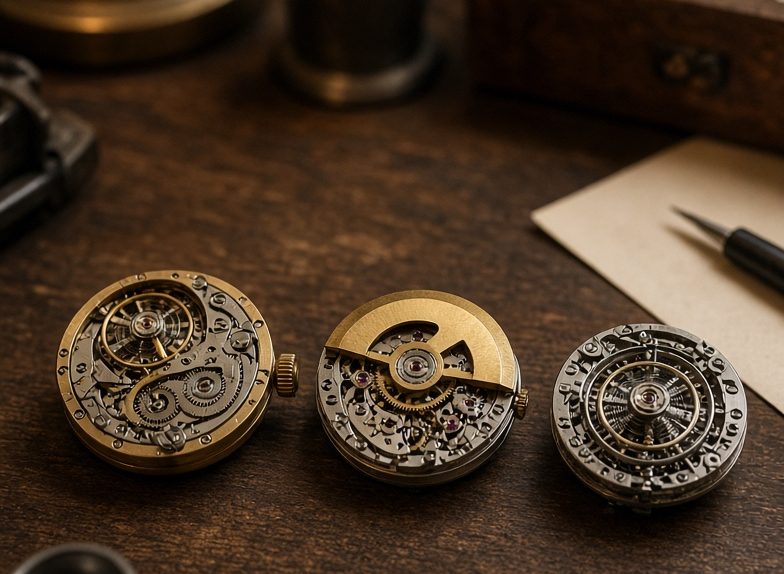
Mechanical watches are powered by a spring-driven movement, with the energy generated by winding the watch transmitting through a series of gears and wheels to power the timekeeping functions. There are several different types of mechanical movements that can be found in mechanical watches, each with its own unique features and characteristics.
- Hand-wound movement – A hand-wound movement requires the wearer to manually wind the watch by turning the crown (the knob on the side of the watch) in a clockwise direction. These movements are often found in vintage or high-end mechanical watches and are known for their precision and reliability.
- Automatic movement – An automatic movement is powered by the movement of the wearer’s wrist. As the wearer moves, a rotor (a weighted metal disc) inside the watch winds the mainspring, generating energy to power the watch. Automatic movements are convenient as they do not require manual winding, but they may not be as precise as hand-wound movements.
- Quartz movement – A quartz movement is powered by an electric current generated by a small battery. These movements are known for their accuracy and low maintenance, as they do not require winding or servicing.
- Tourbillon movement – A tourbillon movement is a highly complex mechanical movement that was invented to improve the accuracy of a watch by counteracting the effects of gravity. These movements are found in high-end watches and are considered a true work of art.
In summary, there are several different types of mechanical movements that can be found in mechanical watches, each with its own unique features and characteristics. Whether hand-wound, automatic, quartz, or tourbillon, all mechanical movements are powered by a spring-driven movement that generates energy to power the timekeeping functions of the watch.
Hand-wound and automatic are both mechanical. The difference is only how the barrel gets its energy: your fingers, or a rotor. Quartz is not a mechanical movement, even when it sits in a vintage-looking case; it is a battery and a stepping motor. A tourbillon is a mechanical complication that rotates the escapement to average out positional error. It is rare in the watches that come through a repair shop in Mississauga, and it is not required for a good watch.
When you buy, name the thing correctly. “Automatic pocket watch” is usually a misunderstanding; almost all American railroad watches are manual-wind. “Quartz railroad style” is a fashion case. If you can see the plates, you can see the absence of a battery. If you cannot open it, a photo through the cuvette is enough to tell mechanical from not.
Have a pocket watch that needs attention? The Good Old Times offers
free, no-fee service estimates (no charge if you decide not to proceed), local drop-off in
Mississauga by appointment, and Canada-wide service by mail — every repair backed by a
3-month warranty. Get a free estimate →
Also browse: fully serviced watches for sale ·
pocket watch guides (Collector’s Corner).