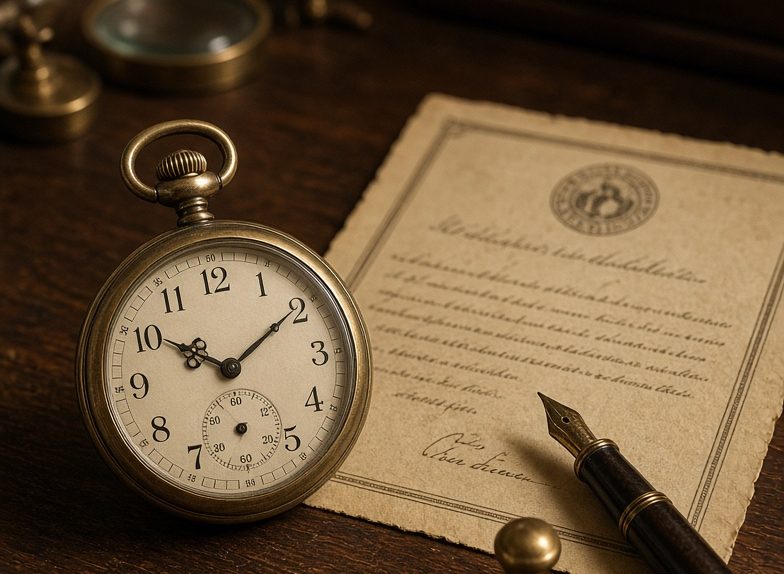
A Railroad Approved pocket watch is essentially synonymous with a railroad grade pocket watch but focuses more on the aspect that the watch has met specific criteria set by railroad companies or watch inspectors to be deemed suitable for railroad use. Here are some details:
- Standards and Specifications:
- Accuracy: As mentioned, these watches needed to maintain accurate time, typically within 30 seconds per week.
- Design: Open-faced design with clear, readable dials featuring Arabic numerals.
- Setting Mechanism: Lever-set mechanism to prevent accidental time changes. Some later models might use pendant set (where the time is set by pulling the crown), but this was less common in earlier standards.
- Approval Process:
- Inspection: Watches had to pass periodic inspections by railroad watch inspectors or jewelers who were authorized to certify timepieces for railroad use.
- Certification: Once a watch met all the criteria, it might be officially certified or marked in some way to indicate its approval for railroad service. This could be through engravings on the watch itself or through documentation provided with the watch.
- Adjustments:
- The watch had to be adjusted to temperature extremes and various positions to ensure reliability under different conditions encountered in railroad service.
- Durability and Maintenance:
- Durability: They were built to withstand the vibrations, shocks, and potential magnetic fields encountered on trains.
- Maintenance: Regular maintenance was required, and the watch’s performance had to be logged.
- Historical Context:
- After significant train accidents, like the one in Kipton, Ohio in 1891, stricter standards were adopted. The accident led to the establishment of more rigorous timekeeping standards by Webb C. Ball, who was appointed Chief Time Inspector. His standards influenced what would be considered “Railroad Approved.”
- Brands:
- Watches from manufacturers like Hamilton, Ball Watch Co., Elgin, Waltham, and others were often approved for railroad use after meeting these standards.
The term “Railroad Approved” signifies that the watch not only was designed with the railroad worker in mind but also passed the rigorous testing and continuous checks required to ensure safety on the rails. Over time, as technology and timekeeping methods evolved (like the introduction of quartz and then digital watches), the strict need for mechanical railroad-approved watches diminished, but they remain significant in the history of horology and railroading.
Approval was a process, not a stamp that lasted forever. A watch could pass in 1910 and fail a later standard if the road tightened the weekly rate or banned pendant-set. Inspectors kept books. A conductor whose watch drifted was sent to have it regulated or replaced. That paper trail is why collectors still argue about “approved” versus “grade”: one is how the watch was built, the other is how it was used on a specific railroad at a specific time.
You will almost never find a complete original inspection card with a watch bought in 2026. Treat listings that promise “railroad approved” as a claim about the grade and the era, then verify the movement. If the watch is a known railroad grade and you want it as a working piece, service it as a precision tool, not as jewelry. If you only want the story, say so before anyone opens it.
Have a pocket watch that needs attention? The Good Old Times offers
free, no-fee service estimates (no charge if you decide not to proceed), local drop-off in
Mississauga by appointment, and Canada-wide service by mail — every repair backed by a
3-month warranty. Get a free estimate →
Also browse: fully serviced watches for sale ·
pocket watch guides (Collector’s Corner).