
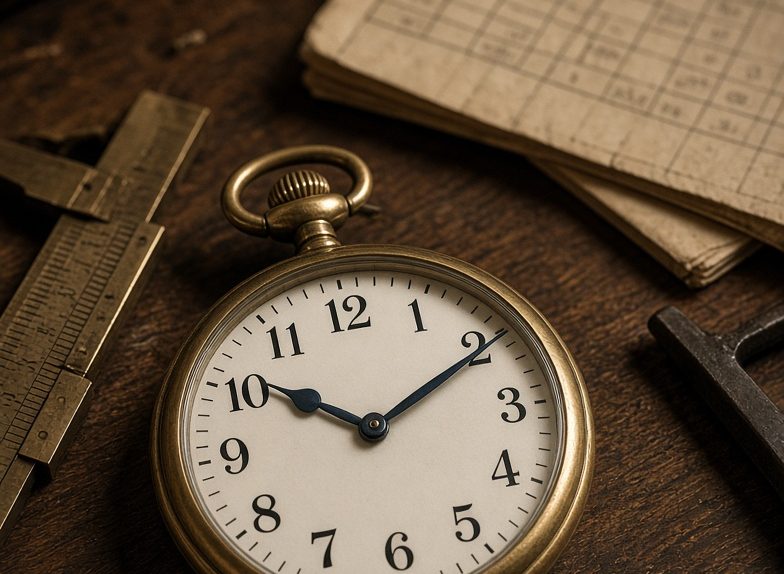
A railroad grade pocket watch is a type of timepiece that was specifically designed and required for use by railroad workers, particularly conductors, engineers, and other train crew members, in the late 19th and early 20th centuries. Here are some key characteristics and requirements that defined a railroad grade pocket watch:
- Accuracy: Railroad watches had to be extremely accurate. They were often required to keep time within 30 seconds per week. This precision was crucial to prevent collisions on the tracks by ensuring all railroad employees operated on the exact same time.
- Open Face: These watches typically had an open face, meaning no protective lid over the watch face, to allow for quick time checks. They were often size 16 or 18, which made them large enough to read easily.
- Lever Setting: To prevent accidental time changes, railroad grade watches were often lever-set. This means the watch’s time could only be set by opening the crystal and pulling out a small lever, then turning the crown, rather than just pulling the crown out directly, which was common in other watches.
- Arabic Numerals: The dials had bold, easily readable Arabic numerals. This was to ensure that the time could be read at a glance under various lighting conditions.
- Adjustments: They were required to be adjusted to at least five positions, temperature, and isochronism (meaning they kept time consistently regardless of how much the mainspring was wound).
- Jewels: High-grade railroad watches had a significant number of jewels (often 17 or more). Jewels are used as bearings to reduce friction at critical points, thus increasing accuracy and longevity.
- Visibility in the Dark: Many had features like bold hands or luminescent numbers for visibility in low light.
- Reliability: They needed to withstand the rigors of railroad work, which included resistance to magnetism, shocks, and changes in position.
- Regulation and Inspection: Railroads often had their own standards, and watches had to be inspected regularly. A watch that passed these rigorous standards would often be marked or certified as railroad grade.
Brands like Hamilton, Waltham (American Watch Co.), Elgin, and Ball were well-known for producing railroad grade watches. The Ball Watch Company, in particular, was pivotal in setting standards for railroad timepieces after a deadly train collision in 1891, which was caused by a timekeeping error.Owning a railroad grade pocket watch today is often seen as possessing a piece of history, reflecting a time when precision in timekeeping was not just about convenience but about safety and coordination on a vast scale.
Those rules were not decoration. A crew that shared the same minute across a division could run trains on a timetable; a crew that did not could occupy the same piece of track. That is why railroad grade is a specification, not a marketing adjective. Size 16 and 18 exist so the dial can be read at arm’s length in a cab. Lever-set exists so a coat cannot change the time. Five positions exist because a watch in a vest does not sit dial-up all day.
When you look at a watch advertised as railroad grade today, check the movement, not the case. A correct grade in a later dress case is still the grade. A cheap movement in a heavy engine-turned case is not. Photograph the plates — jewels, “adjusted,” lever, maker, and serial — and you can tell in one frame whether the claim is real. If you want that watch running, a proper service matters more than a polished case. Estimates for that work are free.
Have a pocket watch that needs attention? The Good Old Times offers
free, no-fee service estimates (no charge if you decide not to proceed), local drop-off in
Mississauga by appointment, and Canada-wide service by mail — every repair backed by a
3-month warranty. Get a free estimate →
Also browse: fully serviced watches for sale ·
pocket watch guides (Collector’s Corner).