
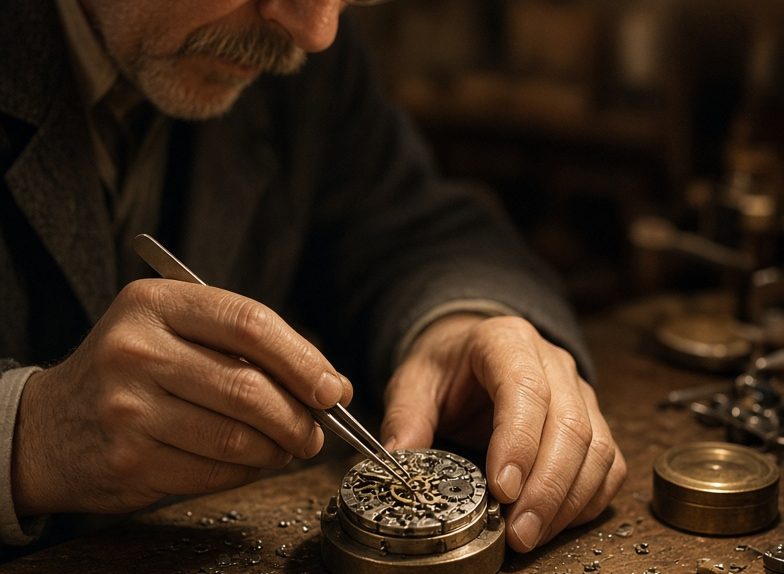
Watchmaking is a skilled trade that involves the creation and repair of mechanical watches. The art of watchmaking involves a deep understanding of the intricate mechanisms that make up a mechanical watch and the skill to assemble and disassemble these parts with precision.
To create a mechanical watch, a watchmaker must first design and plan the movement of the watch. This involves selecting the appropriate gears, wheels, and other mechanical components to achieve the desired timekeeping accuracy and functionality. The watchmaker must then carefully assemble these components, using specialized tools and techniques to ensure that they are properly aligned and functioning correctly.
Once the movement is assembled, the watchmaker must test and calibrate the watch to ensure that it is running accurately. This may involve adjusting the balance wheel, the escapement (the component that regulates the movement of the watch), or other mechanical components to fine-tune the watch’s performance.
Finally, the watchmaker must assemble the case, dial, hands, and bracelet to complete the watch. This process requires attention to detail and a steady hand to ensure that all components are properly aligned and secure.
Overall, the art of watchmaking is a skilled trade that requires a deep understanding of the mechanical components that make up a watch and the ability to assemble and disassemble them with precision. It is a time-honored tradition that requires years of training and practice to master.
Repair is the same art at a smaller scale. You are still aligning pivots in jewels, setting a hairspring so it breathes in the center, and putting oil where it belongs and nowhere else. Factory watchmakers had jigs and runs of identical pieces. A shop restoring a 120-year-old movement has the drawing in the metal itself and whatever parts the aftermarket still holds.
That is why time on the bench does not look like time on a clock. Cleaning cycles, drying, oiling, and a running test cannot be stacked into one hour without skipping something. When a watchmaker says a COA will be ready next week, they are leaving room for the watch to prove it can run. The skill is patience as much as tweezers.
Have a pocket watch that needs attention? The Good Old Times offers
free, no-fee service estimates (no charge if you decide not to proceed), local drop-off in
Mississauga by appointment, and Canada-wide service by mail — every repair backed by a
3-month warranty. Get a free estimate →
Also browse: fully serviced watches for sale ·
pocket watch guides (Collector’s Corner).