
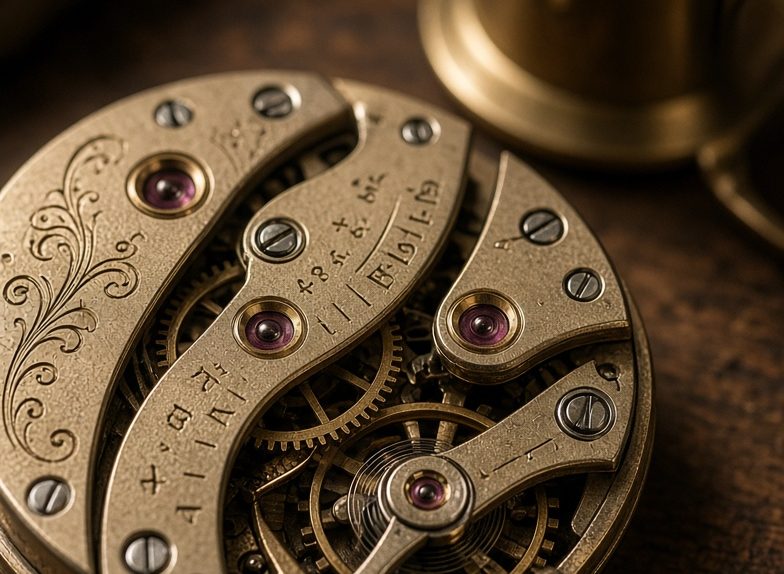
You do not need to be a watchmaker to read an American movement. Three markings do most of the work: size, jewels, and whether it is adjusted.
Size (16s, 18s, and the rest). This is the Lancashire gauge of the movement, not the case diameter in millimetres. 18s is the large “railroad clock” in a pocket; 16s is slightly smaller and became the standard later railroad size. 12s and 0s are smaller still, often dress or ladies’ watches. A 16s movement in an 18s case (or the reverse) is a recase — look twice.
Jewel count. Jewels are hard bearings at high-friction points. More jewels are not automatically “better” past a point, but they are a grade signal:
- 7 jewels — basic watch, often a working-man’s piece.
- 15–17 jewels — mid grade; some early railroad use existed here depending on the era and the road.
- 19–23 jewels — typical high grade and railroad-grade territory when paired with the other requirements.
The number is usually engraved on the movement. Treat a jewel count painted only on a dial with suspicion if the plates do not agree.
“Adjusted.” An adjusted watch was regulated so it keeps time in more than one position and, on better grades, for temperature and isochronism (the rate as the spring winds down). Railroad grades were commonly adjusted to five positions. “Adjusted” without a number still beats an unadjusted 7-jewel, but “adjusted 5 positions” is the phrase collectors look for on a railroad candidate.
Read the plates, not the sales title. If you can photograph the movement, those three facts — size, jewels, adjusted — are enough for a first honest conversation about what the watch is.
A quick field method: open the cuvette, find the maker, find the serial, find the jewel number, find the word adjusted if it is there, then look at the case separately. Write those five things down before you look at the asking price. Most bad purchases happen in the opposite order.
Size mistakes are common in listings that use millimetres from a case measurement. An 18s movement is not “45 mm railroad” in the modern wristwatch sense; it is a gauge. If a seller cannot tell 16s from 18s, they may also have the grade wrong. Ask for a movement photo with a ruler only if you must; a clear plate photo is usually enough. We will read that photo if you want a second pass before you buy.
Have a pocket watch that needs attention? The Good Old Times offers
free, no-fee service estimates (no charge if you decide not to proceed), local drop-off in
Mississauga by appointment, and Canada-wide service by mail — every repair backed by a
3-month warranty. Get a free estimate →
Also browse: fully serviced watches for sale ·
pocket watch guides (Collector’s Corner).