
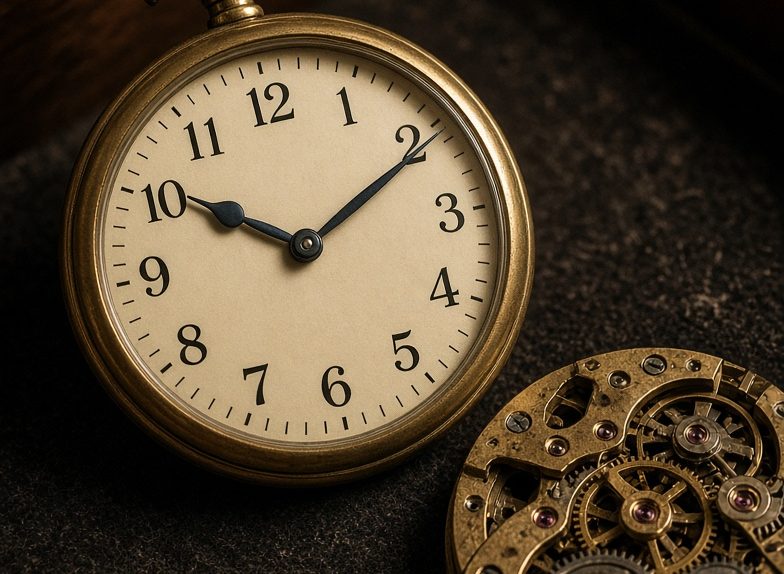
If you spend any time around American railroad watches, you will hear “992” the way guitar people hear “Stratocaster.” Hamilton made the 992 in Lancaster, Pennsylvania, as a 16-size, 21-jewel, lever-set watch adjusted to five positions. The later 992B (introduced in the 1940s) refined the same idea with an improved movement and is the one most people picture when they say “railroad Hamilton.”
Collectors chase them for reasons that are not just nostalgia:
- They met the standard in practice. Accuracy within railroad rules, open face, Arabic numerals, and a lever-set so a conductor could not bump the time by accident.
- Parts and knowledge still exist. A 992/992B is a watch a competent watchmaker can still service properly. That matters more than rarity for something you actually want to run.
- The grade is readable. Unlike a vague “railroad style” case on a cheap movement, a real 992 is identified on the movement. You can verify what you bought.
- They sit in the middle of the market. Not the rarest Hamilton, not the cheapest. A clean, original-dial example with a proper case is still a serious watch without being a museum piece only.
A 992 is not automatically “railroad approved” just because the grade existed. Approval was about inspection in service. And a 992 movement in a later dress case is still a 992 movement — the case does not erase the grade, but collectors pay more for a coherent, period-correct package.
If you are looking at one, photograph the movement markings, the dial, and the case stamps. Condition of the enamel dial and whether the watch has been serviced recently will move the price more than a polished case.
The 992 ran for years before the 992B; the B is the later, cleaner production version most people mean in a casual listing. Both are 16s, 21 jewels, lever-set, built as railroad tools. Collectors argue about dial variants, damaskeening, and whether a particular case is original to the movement. Those arguments matter at the top of the market. For a first railroad watch, a correct, complete, uncracked-dial example that has been serviced is the one to want.
Avoid frankenwatches: a 992 movement dropped into whatever hunter case was in the parts bin, reprint dials sold as factory, “adjusted” engraved last week. Compare serial and markings to known Hamilton patterns. If you already own one and it has not been opened in decades, treat it as a machine that earned a COA, not as a relic that must never run.
Have a pocket watch that needs attention? The Good Old Times offers
free, no-fee service estimates (no charge if you decide not to proceed), local drop-off in
Mississauga by appointment, and Canada-wide service by mail — every repair backed by a
3-month warranty. Get a free estimate →
Also browse: fully serviced watches for sale ·
pocket watch guides (Collector’s Corner).