
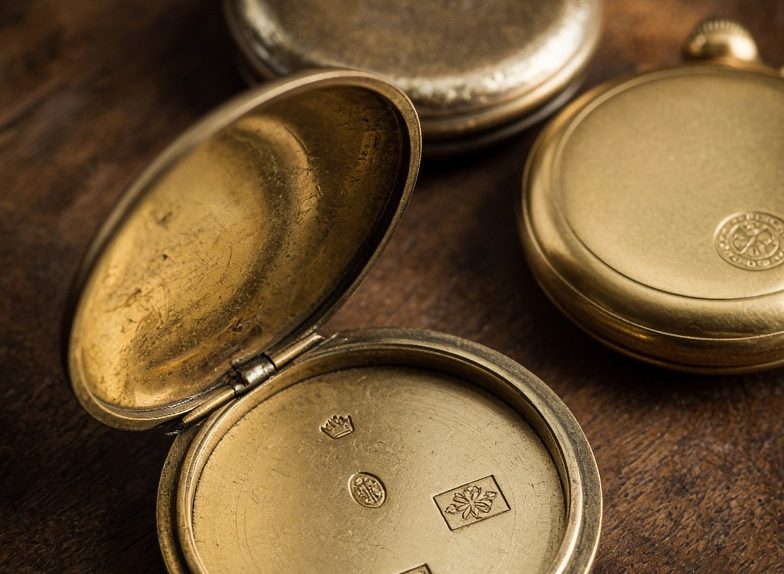
Buyers often assume a yellow case is solid gold. On North American pocket watches from 1850 to 1950, that is usually wrong. The movement and the case were sold separately, and the case is where a lot of the confusion (and the value) sits.
- Solid gold is marked with a karat stamp such as 14K or 18K, sometimes with a maker’s mark. It is the same metal all the way through. These cases are less common on everyday railroad watches because they cost more and dent more easily.
- Gold-filled (often stamped guaranteed 20 years, 25 years, or similar) is a thick layer of gold bonded over a brass core. It is not plating. A proper gold-filled case can last a lifetime of pocket wear. When you see brass showing at the bow or the edge of the back, that is wear-through of a gold-filled case — not proof that someone faked the watch.
- Rolled-gold plate is a thinner gold layer than gold-filled. It wears through sooner. Marks vary by case company; treat “plate” as thinner than “filled.”
- Base metal cases (nickel, silveroid, gun metal) were honest working cases. They are not a defect. Many railroad watches left the factory in nickel.
Open the cuvette (the inner cover over the movement) and look for the case maker, a serial number, and the gold mark. Do not polish a gold-filled case aggressively to “make it yellow again” — you are removing the gold that is left. If you are unsure what you have, send clear photos of the case marks; a short reading of those stamps is part of a normal evaluation.
Case companies were not the movement factories. Keystone, Dueber, Wadsworth and others built the armor; Waltham and Elgin built the engine. That is why a solid-gold case can hold a modest movement, and a nickel case can hold a 23-jewel railroad grade. Value the two objects separately, then add them together.
Do not chase “yellow.” Chase marks and thickness of wear. A gold-filled case with even color and sharp edges is often more honest than a case that has been buffed until the bows are thin. If you plan to sell, say whether you are selling a watch or selling gold. Those are different customers. Photos of the inner case stamps settle the metal question before anyone quotes.
Have a pocket watch that needs attention? The Good Old Times offers
free, no-fee service estimates (no charge if you decide not to proceed), local drop-off in
Mississauga by appointment, and Canada-wide service by mail — every repair backed by a
3-month warranty. Get a free estimate →
Also browse: fully serviced watches for sale ·
pocket watch guides (Collector’s Corner).